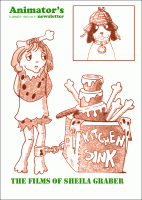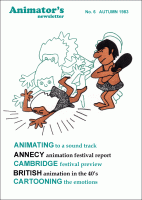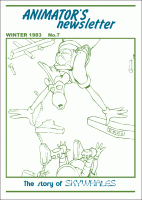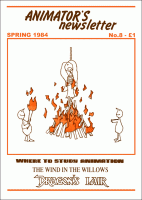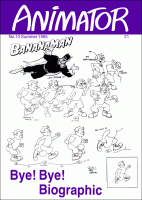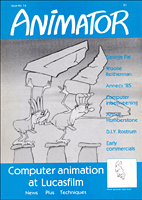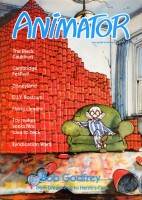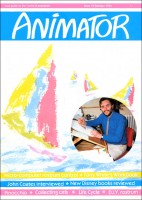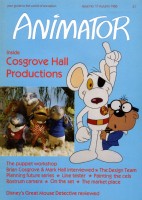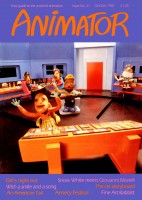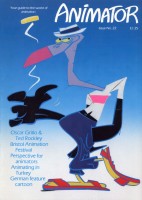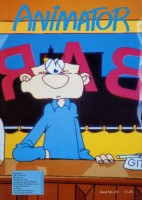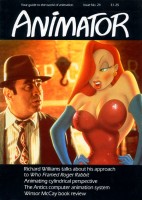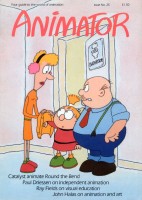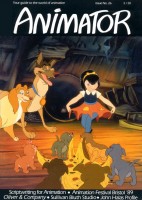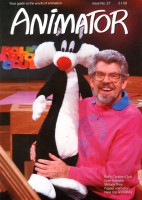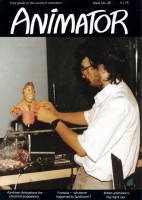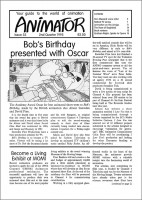
Issue 9 now in the archive

Posted on February 5th, 2010 by David Jefferson.

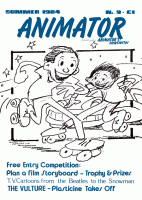
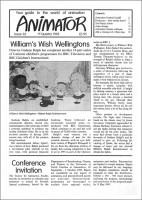
Animator Issue 9. Summer 1984.

TVC Animation Studio from the Beatles to the Snowman
TV Cartoons Limited are better known by their initials TVC. Formed in the summer of 1957 by George Dunning and John Coates.

The Shadows Move – Part Six – the rise of TV animation
The feverish activity that went into the making of Britain’s first entertainment cartoon feature ANIMAL FARM ended, leaving in its wake the pertinent question: What now?

Walk-Run Cycles for Cartoon Animation
Sheila Grabar, well known professional animator, gives us some tips on getting our characters moving.

Feature Films at the Cambridge animation Festival 1983
A strong bunch of films were chosen for the feature section of the Cambridge Festival.

Computer Games in 1984
A comment by Ken Clark.

The Vulture – Plasticine Animation Takes Off
David Coleman tells us about Animated Black Theatre and Camera movements.

Animated Sketch Book – getting good movement
Ian Whitworth, Cosgrove Hall animator, tells how to getting good movement in animated drawings.

The Donald Duck Story
Chris Pearson looks at Donald’s long and eventful career.

Cartoon Storyboards – where do ideas come from?
Getting ideas for cartoons is the biggest problem with most amateur animators.

Using Storyboards for Cartoon Animation
David Jefferson tells of the advantages of using storyboards and looks at two professional storyboards done for TV adverts.

A Matter of Loaf and Death nominated for an Oscar

Posted on February 2nd, 2010 by David Jefferson.

A Matter of Loaf and Death

The Wallace and Gromit TV short “A Matter of Loaf and Death” has been nominated for an Oscar for best animated short film in the 82nd Academy Awards. It was made at the Aardman animation studio and directed by Nick Park. Nick has previously been Oscar nominated five times and won four times (the fifth nomination was against another of his own films).

A Matter of Loaf and Death was the big TV hit of Christmas 2008 and features the voices of Geraldine McEwan, Peter Sallis and Sally Lindsay.

In the movie Wallace and Gromit have opened a bakery and business is booming, mainly because a Cereal Killer has murdered all the other bakers in town. Gromit is worried that they may be the next victims, but Wallace does not care, as he has fallen head over heels in love with former star of the Bake-O-Lite bread commercials, Piella Bakewell. Then Gromit makes a shocking discovery which points to the killer’s true identity. Can he save his master from becoming the next baker to be butchered?

In an interview with Times Online it was pointed out that there are fingerprints in the Plasticine characters. Nick Park replied; “We’re very proud that it’s hand-made, and we don’t want to tidy things up too much. Those thumb prints are a reminder of the work that went into it.”

See the other nominations on the Oscars website.

There is a fascinating behind the scenes video entitled “Wallace and Gromit – A Matter of Loaf and Death – How They Donut” on the Aardman’s channel at the YouTube website.

A Matter of Loaf and Death – How They Donut

MonkeyJam digital pencil test software reviewed

Posted on January 30th, 2010 by David Jefferson.

MonkeyJam is a free digital pencil test program that runs on the Windows operating system. It lets you capture images from a webcam, camcorder, or scanner and assemble the separate frames into an animation. You can also import existing images and sound files from your computer. Although it is designed for pencil and paper, MonkeyJam can also be used for stop-motion animation. Once you have created your movie it can be exported as an AVI file.

MonkeyJam information panel (click pic to enlarge)

The MonkeyJam software downloaded and installed on my PC without problems. The program starts with a window containing an information panel and a frame list. There is a help file with a quick start section to give the basics.

The first step is to select a folder to store your image files. The nest step is to select a method of adding your images to the frame list. This can be from a video source such as webcam or from a scanner. Alternatively you can import existing image files that you already have on you computer.

For the purposed of this test I decided to use the stills that I had created for my bouncing ball demonstration. It was simply a matter of selecting the images from the computer and clicking the import button. To view the animation you select Preview from the Tools menu and the software builds your movie and opens another window to play it back. It is as simple as that. You can then export your movie to an AVI file for sharing with others, such as uploading to YouTube.

MonkeyJam preview window (click pic to enlarge)

You can add sound to your movie in the form of WAV or MP3 audio files. Once imported into MonkeyJam the audio file is displayed as a waveform to the right of the frame numbers. The audio can be scrubbed in the exposure-sheet by running the mouse curser along it, played with the animation in the Preview window and exported as part of the AVI.

You can’t adjust the sound file once it is in MonkeyJam. Only one sound file can be imported per exposure-sheet and it always starts on frame one. This is fine if you are animating to a pre-existing sound track. If you want to fit the sound to pre-existing animation you need to use another program to edit the sound.

I can recommend this program as a straightforward line test and frame capture program, especially as it is free. If you want something with more sound and image editing capabilities then I would suggest you look at purchasing something like Stop Motion Pro.

Visit the MonkeyJam website to download the free software.

If you found this review useful please let us know in a comment to this post.

Barry Purves to do Masterclass at Norwich Puppet Theatre

Posted on January 28th, 2010 by David Jefferson.

Barry Purves

Oscar and BAFTA-nominated animation director Barry Purves will lead a two day discussion and celebration of puppets in all their many and varied forms, from the most basic rod puppets to stop motion animation figures.

The event entitled PASSION, PROCESS and PERFORMANCE takes place on Monday 22 and Tuesday 23 February 2010 at the Norwich Puppet Theatre, in Norwich, UK.

Barry Purves will not only look at the different techniques, but also at why puppets, and the relationship between puppets and puppeteers, are such a fundamental element of all cultures throughout history. With the group he will try to answer ‘what are puppets?’ and ‘why do we need them?’

In the evening Barry will screen a selection of his own and some of his favourite films in full.

Barry has animated on and directed many series for television such as The Wind in the Willows, Rupert Bear, and most recently, Bob the Builder. He has worked in significant roles on such feature films as Mars Attacks and King Kong, and directed over 60 commercials and titles sequences, including a current campaign for Marketing Manchester.

Barry’s talk is based on discussions in his first book: “Stop Motion – passion, process, performance” which was released last year. Using animation as a catalyst, it looks at the creative process of many media. A second publication: “Animation Basics – Stop Motion”, will be released in early 2010 and will be aimed at students and first time animators.

You will find more details and booking information on the Norwich Puppet Theatre website.

Have you read Barry Purves’ book “Stop Motion – passion, process, performance”? If you have please share your thoughts on it in a comment to this post.

Emma Lazenby’s “Mother of Many” from script to screen

Posted on January 26th, 2010 by David Jefferson.

Mother of Many

Emma Lazenby’s film “Mother of Many” has just been nominated for a BAFTA in the Best Short Animation category. Emma has documented the making of her film in a fascinating blog called MoM written under the pen name of ElsieDarkwinter.

“Mother of Many” is based around the rhythms of a baby inside the womb and the rhythms and day to day routine of the midwife being calm and controlled – leading women through the most life-changing and challenging event of their lives. It was made using real recordings of childbirths and foetal heartbeats, combining painting on glass, hand drawn animation, Flash and After-Effects.

The blog starts back in March 2009 where we find Emma doing rewrites for her script. She writes; “I am having a lot of difficulty. I have written a script – first second and now on my third draft. It feels like I just rewrite the same script every time. It is changing slowly, but with the constant deadlines, I feel I have to keep finishing each script and never address any of the things that are bothering me. I just rush, panic, fluster and beat myself up a bit.”

Emma tells how she got the idea for the film; “The film is about midwifery, and is a celebration of my mum, who did this job for 30 years – delivering thousands of babies and a large percentage of the local population. I started thinking about it a year ago when she retired. It feels like an idea with some point, the point being to do a job with meaning.”

By the middle of April ‘09 the script is coming together. Emma writes; “…all the people (the funding ones) have said they are much happier with the new script (third draft) and I have been storyboarding roughly, doing some more work on design.”

Early May ’09 finds Emma working on her animatic. She says: “Animatics are nice – because you see the film, but not so nice, because the drawings are all so scrappy.”

By mid-May the animatic has been approved and Emma announces; “Today has been the start of making the film. I designed some pregnant women, made a list of things I have to do and how each scene works.”

In June ’09 Emma talks about the sound track. She has given her recording machine to an independent midwife in the hope of getting some authentic sound. She writes that she is “…waiting for women to pop who will let us record them grunting and screaming or just breathing calmly depending on how the births go.”

Emma Lazenby painting under camera (picture from MoM blog).

In July ’09 Emma has some animators working on her film but she wishes she could find the time to animate herself. She seems to be constantly on call to make decisions, emailing, talking and designing. She is determined to find a way; “This week I am in a little room away from email and everybody and everything – painting and playing under camera to make nice womb textures and contractions – it is lovely.”

By mid-September ’09 the film is nearing completion. Emma writes; “I am going to London tomorrow to help with the sound mix at Fonic. I am really looking forward to seeing it with proper sound instead of my cobbled together stuff.”

In late September the film is finally finished and Emma has mixed feelings. She writes; “I have no idea what I have made or what it looks like – if it is good or bad – whether I like it or not. I feel rather weird really but so excited. It is so odd to get to the end.”

The film’s BAFTA nomination is announced in January 2010 and Emma makes a blog post. She begins; “I am really quite shocked and it is only sinking in that my film has been nominated for a BAFTA. It is ridiculously exciting.”

You can read the full account of the making of “Mother of Many” in Emma Lazenby’s blog MoM.

Watch a clip of “Mother of Many” on YouTube.

See the full list of BAFTA award nominations.

Have you seen “Mother of Many”? Please share your thoughts on the movie in a comment to this post.

Nintendo DS animation with the Colors! program

Posted on January 24th, 2010 by David Jefferson.

Colors! is a painting program that takes advantage of the pressure sensitivity of the Nintendo DS touch-screen to create a digital sketch-book. Animator Sheila Graber, who has been experimenting with it, told us; “It is great for ‘smudge and click’ as I used to call it in ye pastel days when I used 16mm film. It is SO much easier using this programe and you don’t get your hands dirty! I can recommend it for animators of today”.

During her long and illustrious career Sheila has produced a number of “face to face” movies where one face dissolves into another. Now she has produced one using Colors! called “Facelife”. It covers life from cradle to grave through various faces.


Facelife, by Sheila Graber.

You can find out more about the program at the Colors! website. There you will find a FAQ page that tells you all you need to know about running the program on your Nintendo DS, a gallery of drawings produced with Colors! and a page where you can download the program free.

Another animation program for the Nintendo DSi is Flipnote Studio. This has an onion skin feature so that you can see your previous drawings. You can also record sound and add sound effects to your animation. However, it does not appear to use the pressure sensitivity of the touch-screen like the Colors! program. Flipnote Studio is available as a free download from the Nintendo DSi Shop.

If you have used either of these programs let us know your thoughts about them in a comment to this post.

Behind the scenes of Coraline

Posted on January 22nd, 2010 by David Jefferson.

Coraline

A series of short videos about the making of the animated puppet film “Coraline” can be viewed on the Film in Focus website. Coraline is directed by Henry Selick and is said to be the first stop-motion animated puppet adventure to be originally filmed in 3D.

It is the story of Coraline Jones, who is bored in her new home until she finds a secret door and discovers an alternate version of her life on the other side. This parallel reality seems much better than her real life to start with, but then this seemingly perfect world turns dangerous – and the fun begins.

There are ten behind-the -scenes videos, each running for two to three minutes.

The one called “Bringing It To Life Featurette” uses speeded up footage to show the animators at work. There are also clips from the movie interspersed with interviews with the film makers.

A video called “Brian and Martin Featurette” concentrates on a scene where Coraline gets accidentally soaked from a bath shower. To animate the water they created a series of plastic models of the spray water and substituted them one frame at a time.

The “3D Featurette” demonstrates how they set about shooting the two viewpoints necessary for 3D using just one camera.

Let us know your thoughts on these behind the scenes videos in a comment to this post.

Aardman shorts added to free film site

Posted on January 20th, 2010 by David Jefferson.

A collection of 13 short films from the Aardman Animations studio have been added to a film site called Indie Movies Online. The movies are free to watch although you do have to sit through a 30 second advert before the movie plays.

Among the movies on offer are Peter Lord’s Oscar-nominated Adam in which God is attempting to lay down some rules to the first man on Earth – while Adam himself is longing for somebody to keep him company. Plasticine animation.

Will Becher’s Boxed In centres on an old man, living alone in a sparse room. But when a mouse incurs into his tiny world, he rediscovers some purpose and vigor. Puppet animation.

Creature Comfortsis the Oscar-winning short from Wallace and Gromit creator Nick Park, in which interviews with the public are used to put words in animal mouths. Plasticine animation.

Adam, Boxed In and Creature Comforts from Aardman Animations studio.

Let us know your favourite out of this Aardman collection in a comment to this post.

Ray Harryhausen Chronicles on YouTube

Posted on January 18th, 2010 by David Jefferson.

Skeleton warriors from Jason and the Argonauts.

If you are an aspiring puppet animator you can now learn from the master of fantasy animation in a series of movies on YouTube. Some of Harryhausen’s most notable works have included his animation on Mighty Joe Young made with pioneer Willis O’Brien, which won the Academy Award for special effects in 1949, The 7th Voyage of Sinbad and Jason and the Argonauts, featuring a famous sword fight against six skeleton warriors.

The Harryhausen Chronicles documentary, narrated by Leonard Nimoy, covers much of his work with some great close-ups of his puppets and lots of advice from the master himself. In the introduction Ray Harryhausen says: “Fantasy is a dream world and I don’t think you want it quite real. You want an interpretation and stop motion gives it an added value that you can’t catch if you try to make it too real.”

The Harryhausen Chronicles are split into six parts. The links are below:

Part 1
Part 2
Part 3
Part 4
Part 5
Part 6

What is you most memorable Harryhausen movie?

Animation Festivals Directory reviewed

Posted on January 16th, 2010 by David Jefferson.

Animation Festivals website.

If you are a professional or student animator looking for a list of forthcoming animation festivals then the Animation Festivals Directory may be the answer. Their website is run by a small, but dedicated team, who aim to provide the International animation community with a constantly updated directory of festival listings. The website is completely free to use; their only request is that if you see a listing that is either out of date or incorrect, you let them know. That way the community constantly benefits.

Unless you have been in the animation industry for a number of years and built up your own database of festivals, there are very few places, if any, where you can find up to date festival listings all year round. The Animation Festivals Directory was born out of this need for a comprehensive directory of animation festivals around the world.

Whereas there are many film festivals out there, and it is not difficult to obtain a listing of these, it is a time consuming task finding out which ones accept animation. Students, producers, directors and others do not have the time or resources to search for the relevant festivals amongst all the others. Animation-festivals.com is a very specific online resource which aims to take this headache away.